


Lidé používají dýmky po tisíce let. Snad první použití byli starověcí zemědělci, kteří odváděli vodu z potoků a řek do svých polí. Archeologické důkazy naznačují, že Číňané používali rákosovou dýmku k přepravě vody na požadovaná místa již 2000 0010010 nbsp;B.C. & nbsp;Clay tubes that were used by other ancient civilizations have been discovered. During the first century & nbsp;A.D. & nbsp;, the first lead pipes were constructed in Europe. In tropical countries, bamboo tubes were used to transport water. Colonial Americans used wood for a similar purpose. In 1652, the first waterworks was made in Boston using hollow logs.
Development of the modern day welded steel pipe can be traced back to the early 1800s. In 1815, William Murdock invented a coal burning lamp system. To fit the entire city of London with these lights, Murdock joined together the barrels from discarded muskets. He used this continuous pipeline to transport the coal gas. When his lighting system proved successful a greater demand was created for long metal tubes. To produce enough tubes to meet this demand, a variety of inventors set to work on developing new pipe making processes.
An early notable method for producing metal tubes quickly and inexpensively was patented by James Russell in 1824. In his method, tubes were created by joining together opposite edges of a flat iron strip. The metal was first heated until it was malleable. Using a drop hammer, the edges folded together and welded. The pipe was finished by passing it through a groove and rolling mill.
Russell & # 39; s metoda nebyla používána dlouho, protože v příštím roce, Comelius Whitehouse vyvinul lepší metodu pro výrobu kovových trubek. Tento proces, nazývaný svařování na tupo -, je základem našich současných postupů vytváření trubek -. Při této metodě byly tenké plechy železa zahřívány a protahovány kuželem - ve tvaru otvoru. Jak kov prošel otvorem, jeho okraje se stočily a vytvořily tvar trubky. Oba konce byly svařeny k dokončení potrubí. První výrobní závod k použití
this process in the United States was opened in 1832 in Philadelphia.
Gradually, improvements were made in the Whitehouse method. One of the most important innovations was introduced by John Moon in 1911. He suggested the continuous process method in which a manufacturing plant could produce pipe in an unending stream. He built machinery for this specific purpose and many pipe manufacturing facilities adopted it.
While the welded tube processes were being developed, a need for seamless metal pipes arouse. Seamless pipes are those which do not have a welded seam. They were first made by drilling a hole through the center of a solid cylinder. This method was developed during the late 1800s. These types of pipes were perfect for bicycle frames because they have thin walls, are lightweight but are strong. In 1895, the first plant to produce seamless tubes was built. As bicycle manufacturing gave way to auto manufacturing, seamless tubes were still needed for gasoline and oil lines. This demand was made even greater as larger oil deposits were found.
As early as 1840, ironworkers could already produce seamless tubes. In one method, a hole was drilled through a solid metal, round billet. The billet was then heated and drawn through a series of dies which elongated it to form a pipe. This method was inefficient because it was difficult to drill the hole in the center. This resulted in an uneven pipe with one side being thicker than the other. In 1888, an improved method was awarded a patent. In this process the solid billed was cast around a fireproof brick core. When it was cooled, the brick was removed leaving a hole in the middle. Since then new roller techniques have replaced these methods.
Design
Existují dva typy ocelových trubek, jeden je bezešvý a druhý má po celé délce jediný svařovaný šev. Oba mají různá použití. Bezešvé trubky jsou obvykle lehčí a mají tenčí stěny. Používají se pro jízdní kola a přepravu kapalin. Zúžené trubky jsou těžší a pevnější. Mají lepší konzistenci a jsou obvykle rovnější. Používají se pro věci, jako je přeprava plynu, elektrické vedení a instalatérské práce. Obvykle se používají v případech, kdy trubka není vystavena vysokému stupni napětí.
Certain pipe characteristics can be controlled during production. For example, the diameter of the pipe is often modified depending how it will be used. The diameter can range from tiny pipes used to make hypodermic needles, to large pipes used to transport gas throughout a city. The wall thickness of the pipe can also be controlled. Often the type of steel will also have an impact on pipe & #39;s the strength and flexibility. Other controllable characteristics include length, coating material, and end finish.
Suroviny
Primární surovinou při výrobě trubek je ocel. Ocel je vyrobena převážně ze železa. Mezi další kovy, které mohou být ve slitině přítomny, patří hliník, mangan, titan, wolfram, vanad a zirkon. Některé dokončovací materiály se někdy používají během výroby. Například může být barva
používá se, pokud je trubka potažena. Typicky se na ocelové trubky na konci výrobní linky nanáší malé množství oleje. To pomáhá chránit potrubí. I když to ve skutečnosti není součástí konečného produktu, k čištění potrubí se v jednom výrobním kroku používá kyselina sírová.
Výroba
Proces
Steel pipes are made by two different processes. The overall production method for both processes involves three steps. First, raw steel is converted into a more workable form. Next, the pipe is formed on a continuous or semicontinuous production line. Finally, the pipe is cut and modified to meet the customer & #39;s needs.
Výroba ingotu
1 Roztavená ocel se vyrábí tavením železné rudy a koksu (látka bohatá na uhlík -, která vzniká, když se uhlí zahřívá v nepřítomnosti vzduchu) v peci, a poté se většina uhlíku odstraní tryskáním kyslíku do kapaliny. Roztavená ocel se potom nalije do velkých, silných - zděných železných forem, kde se ochladí na ingoty.
2 In order to form flat products such as plates and sheets, or long products such as bars and rods, ingots are shaped between large rollers under enormous pressure.
Produkce květů a desek
3 Za účelem vytvoření květu je ingot veden dvojicí drážkovaných ocelových válců, které jsou naskládány. Tyto typy válců se nazývají & quot; dva - vysoké mlýny. & quot; V některých případech se používají tři válce. Válečky jsou namontovány tak, aby se jejich drážky shodovaly a pohybovaly se v opačných směrech. Tato akce způsobí, že se ocel stlačí a natáhne na tenčí, delší kusy. Když jsou válečky obráceny lidským operátorem, ocel je stažena zpět tím, že je tenčí a delší. Tento proces se opakuje, dokud ocel nedosáhne požadovaného tvaru. Během tohoto procesu stroje nazývané manipulátory převracejí ocel tak, aby každá strana byla zpracována rovnoměrně.
4 Ingots may also be rolled into slabs in a process that is similar to the bloom making process. The steel is passed through a pair of stacked rollers which stretch it. However, there are also rollers mounted on the side to control the width of the slabs. When the steel acquires the desired shape, the uneven ends are cut off and the slabs or blooms are cut into shorter pieces.
Další zpracování
5 Blooms are typically processed further before they are made into pipes. Blooms are converted into billets by putting them through more rolling devices which make them longer and more narrow. The billets are cut by devices known as flying shears. These are a pair of synchronized shears that race along with the moving billet and cut it. This allows efficient cuts without stopping the manufacturing process. These billets are stacked and will eventually become seamless pipe.
6 Slabs are also reworked. To make them malleable, they are first heated to 2,200° F (1,204° C). This causes an oxide coating to form on the surface of the slab. This coating is broken off with a scale breaker and high pressure water spray. The slabs are then sent through a series of rollers on a hot mill and made into thin narrow strips of steel called skelp. This mill can be as long as a half mile. As the slabs pass through the rollers, they become thinner and longer. In the course of about three minutes a single slab can be converted from a 6 in (15.2 cm) thick piece of steel to a thin steel ribbon that can be a quarter mile long.
7 After stretching, the steel is pickled. This process involves running it through a series of tanks that contain sulfuric acid to clean the metal. To finish, it is rinsed with cold and hot water, dried and then rolled up on large spools and packaged for transport to a pipe making facility.
Výroba potrubí
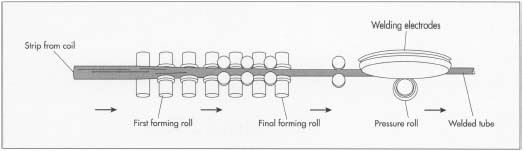
8 Both skelp and billets are used to make pipes. Skelp is made into welded pipe. It is first placed on an unwinding machine. As the spool of steel is unwound, it is heated. The steel is then passed through a series of grooved rollers. As it passes by, the rollers cause the edges of the skelp to curl together. This forms an unwelded pipe.
9 The steel next passes by welding electrodes. These devices seal the two ends of the pipe together. The welded seam is then passed through a high pressure roller which helps create a tight weld. The pipe is then cut to a desired length and stacked for further processing. Welded steel pipe is a continuous process and depending on the size of the pipe, it can be made as fast as 1,100 ft (335.3 m) per minute.
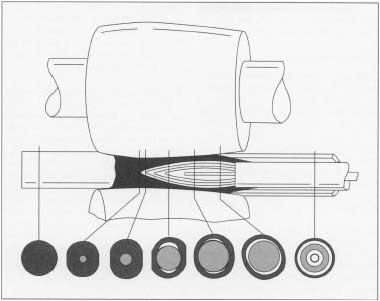
10 Je-li potřeba plynulá trubka, používají se k výrobě čtvercové sochory. Jsou zahřívány a formovány do tvaru válce, nazývaného také kulatý. Kruh se potom vloží do pece, kde se zahřeje na bílou - horkou. Zahřáté kolo se potom válí s velkým tlakem. Toto vysokotlaké válcování způsobí, že se sochor roztáhne a ve středu se vytvoří díra. Protože tato díra má nepravidelný tvar, bod propichovacího kulka je při válcování tlačen středem sochoru. Po fázi propichování může mít trubka stále nepravidelnou tloušťku a tvar. Aby se to napravilo, prochází další sérií válcovacích stolic.
Konečné zpracování
11 After either type of pipe is made, they may be put through a straightening machine. They may also be fitted with joints so two or more pieces of pipe can be connected. The most common type of joint for pipes with smaller diameters is threading—tight grooves that are cut into the end of the pipe. The pipes are also sent through a measuring machine. This information along with other quality control data is automatically stenciled on the pipe. The pipe is then sprayed with a light coating of protective oil. Most pipe is typically treated to prevent it from rusting. This is done by galvanizing it or giving it a coating of zinc. Depending on the use of the pipe, other paints or coatings may be used.


